

A building materials supplier can have an attractive showroom and still leave an important question unanswered: who is responsible for delivering each item in your order?
For a project combining doors, windows, cabinets and finishes, verification works best when it follows the actual purchase. Start with the company you will buy from, identify who makes or sources each category, and check whether the proposed products and working process fit your drawings. A large catalog is useful for selection; it is not, by itself, evidence that every category comes from one production line.
Check identity, capability and order scope separately
These checks serve different purposes. Identifying the business does not establish its production capacity. Seeing a factory does not establish that the factory will make your chosen product. A satisfactory sample does not define every item or accessory included in the quotation.
SGS makes a similar distinction in its ValiTrade service description: documentation verification, on-site verification and checks before dispatch are separate activities. Use that distinction to organize your questions, not as a reason to order every available service. SGS ValiTrade
On a small screen, scroll the table horizontally to view all columns.
| Question | Information to request | What it does not establish on its own |
|---|---|---|
| Which business will supply the order? | The company name used in the quotation and order documents, with an explanation of any different trading or brand name | Product quality or capacity |
| Who is responsible for each category? | A product-by-product description of manufacturing and sourcing responsibility | That every item is made in one factory |
| Can the proposed source handle this scope? | Relevant process information, available production arrangements and how the proposed schedule will be reviewed | A guaranteed delivery date |
| What exactly is being quoted? | Item references, specifications, drawings, inclusions and exclusions | That a general catalog photograph defines the order |
| How will changes be handled? | The person responsible for questions, revisions, approval and follow-up | That an informal conversation changes the accepted order |
Keep unanswered questions visible. “Pending confirmation” is more useful than a tick beside a question nobody has answered.
Connect the company profile to the quotation
Request the supplier’s company information and compare the names used across the profile, quotation and proposed order documents. If they differ, ask for an explanation of the relationship. A brand name and a company name can legitimately be different; the useful result is a clear record of which entity is responsible for the transaction.
Keep brand history, business registration information and platform account age in separate fields. They describe different things. Do not treat one date as a substitute for the others.
When further company verification is needed, use the appropriate official records or a qualified service for the jurisdiction and scope. A directory listing is a starting point, not a completed assessment. Even the U.S. Commercial Service’s own China Business Service Providers directory explains that inclusion is not an endorsement and recommends independent background research. That directory concerns professional service providers; it is not a certification list for building materials suppliers. U.S. Commercial Service directory guidance
Ask who makes, checks and coordinates each product
Instead of asking only “Are you a factory?”, ask the supplier to describe the route for your selected products.
For example, a supplier may manufacture one category and coordinate another with a separate source. That arrangement is not automatically a problem. What matters is whether the quotation and working process make the responsibilities clear.
A simple responsibility map can include:
- Product definition: who answers questions about the proposed construction, dimensions and options?
- Production or sourcing: which party is responsible for obtaining the approved item?
- Revision control: who issues an updated quotation or drawing when a detail changes?
- Order review: who checks the agreed items and records unresolved differences?
- Packing and follow-up: who maintains the item and package references and handles later questions?
Apply this map to the actual categories in the order. A strong answer about cabinet production does not resolve the same questions for windows.
Turn a workshop image into a specific follow-up question
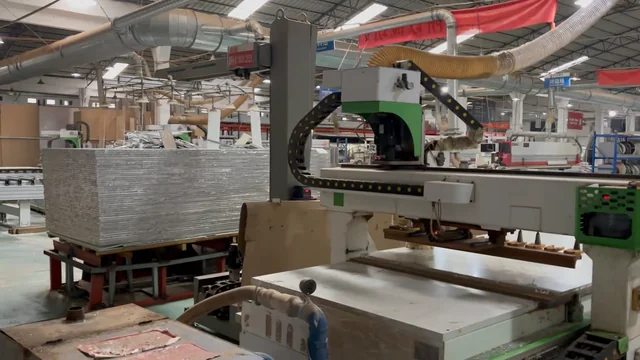
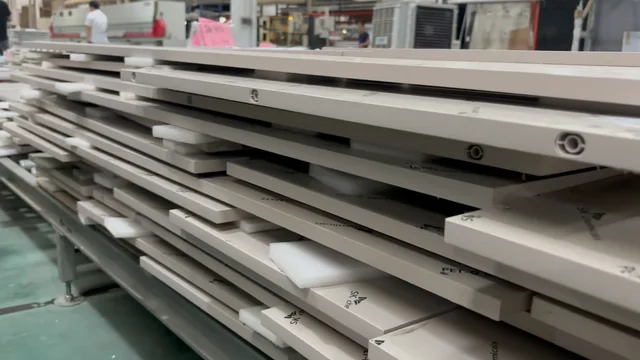
These two workshop video stills show equipment and furniture components from different viewpoints, not a documented sequence for one order. Use each view to ask for the missing information that connects the scene to your proposed product.
1. Equipment and a panel: ask about the work, not the machine's appearance. A panel is visible beneath a gantry assembly, with sheet material stacked beside it. Ask the supplier which operation is shown, which component it concerns, and whether that component is part of the item being quoted. Keep the answer with the relevant product or drawing reference. The frame alone does not identify the operation or establish machining accuracy.
2. Component details: ask what the visible features belong to. The closer view shows circular openings at panel edges and white spacers between components. Ask for the component name and its matching drawing detail. If a fitting uses these openings, request the proposed fitting reference and dimensions in writing. Visible holes do not establish their tolerance, the panel's internal construction or an assembled unit's performance.
For your inquiry, pair each selected image with three fields: what is visible, which quoted item it relates to, and what remains to be confirmed. Leave the item reference blank until the supplier provides the connection; do not infer it from a similar colour or shape. See our factory and quality support page for the wider site context.
Look for capability relevant to your order
A general factory video can help you understand a business, but ask how the relevant process connects to the products being quoted. If you are ordering multiple finishes or custom sizes, the useful discussion concerns those variations, not only the largest machine in the building.
Professional vendor assessments can consider current workload, equipment capability, material control, storage arrangements and personnel resources. SGS lists these among its assessment areas. Those are examples of what an assessment can examine; they are not evidence that any particular supplier has passed one. SGS vendor assessment and technical audit
For an initial supplier discussion, select the few questions that matter most to your project. Ask how the source will review the quantity, customization and required timing. If the order warrants an independent assessment, agree its scope around those questions.
Make a sample answer a specific question
Before requesting a sample, write down what you expect to learn from it. Are you reviewing a visible finish, an edge detail, a handle, a profile section or a complete operating unit?
Label the accepted reference and connect it to the quotation. Record its limits as well. A finish sample can help confirm appearance, but it does not establish the dimensions, internal construction or performance of every proposed product.
For a door or window requiring particular performance, keep the relevant evidence linked to the proposed configuration. Do not infer that requirement from a showroom display. The existing window specification guide covers configuration and document matching in more detail.
Make the sample reference precise

This supplied image shows several visible finish and profile directions. When discussing one option, name the selected reference instead of asking for “the wood-colored one.”
- Identify the selected profile and finish.
- Record the sample or agreed reference code.
- Confirm supplied dimensions and construction separately.
- Keep the accepted reference with the quotation revision.
The image is not proof of a wood species, current stock, product performance or approval of a particular customer order.
A real document: which fields should you match?
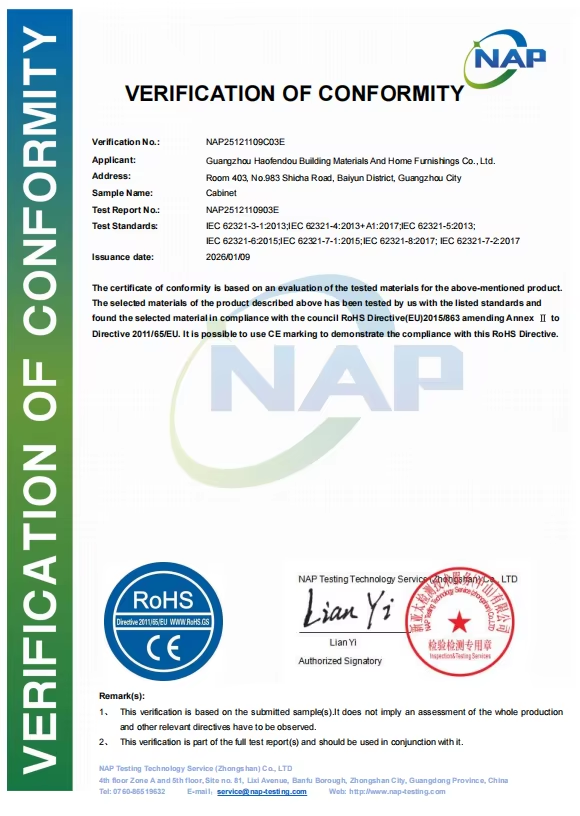
Read the fields, not only the logo. The image names Guangzhou Haofendou Building Materials And Home Furnishings Co., Ltd. as applicant and Cabinet as sample.
- Verification: NAP25121109C03E
- Test report: NAP2512110903E
- Issued: 9 January 2026
Ask for the full referenced report and the connection between its submitted sample and your proposed product.
This document covers the submitted cabinet sample only; read it together with the full test report. Full-report review and issuer confirmation remain separate checks.
Use a small comparison record instead of an overall “trust score”
A supplier comparison should preserve the differences you need to resolve. One overall score can hide an unanswered question behind several attractive features.
Illustrative example — not a HARDWORKING customer order: a project buyer is reviewing interior doors and kitchen cabinets from a one-stop supplier.
On a small screen, scroll the table horizontally to view all columns.
| Review item | Information received | Next decision |
|---|---|---|
| Company identity | The quotation names the supplying company; the catalog uses a separate brand name | Retain the written explanation connecting the names |
| Interior doors | Product references and finish options are identified; the frame scope is unclear | Request an itemized frame and hardware response before comparing the door price |
| Kitchen cabinets | A finish sample is identified, but the layout is still preliminary | Keep the sample as an appearance reference; obtain the revised layout and specification |
| Category responsibility | Cabinet production and door sourcing follow different routes | Name the responsible contact and review process for each category |
| Mixed shipment | A combined shipment is proposed, but package identification is unresolved | Confirm how room and item references will appear in packing information |
The record does not declare the supplier good or bad. It makes the remaining decisions specific enough to resolve. After each clarification, update the affected row and retain the supporting reply or revised document.
Questions before supplier selection
Is buying from a factory always better than using a sourcing partner?
Not necessarily. Compare the actual product fit, responsibilities and service scope. A factory-focused offer and a coordinated multi-category offer can solve different purchasing tasks. Avoid comparing their prices as though their inclusions are identical.
Does a verified supplier badge confirm the product I want to buy?
Check what the assessment covered, which business it applies to and when it was completed. Supplier verification and evidence for a particular product configuration are different checks. Neither should be substituted for the other.
Do I need an independent assessment for every inquiry?
Choose the depth of review against the order and the questions still open. An early inquiry can begin with company information, product references and a clear responsibility map. A more substantial or unfamiliar supply arrangement may justify additional verification before commitment.
What should I send to get a more useful supplier response?
Send a product list, quantities, destination, relevant drawings and the points you need clarified. The building materials RFQ checklist helps organize those inputs so the supplier can answer against a defined project.
Start with the products and responsibilities your project needs
HARDWORKING supports own-factory customization and coordinated multi-category sourcing, with product-specific responsibility confirmed through quotation and order information. You can review the current approach on the factory and quality support page.
Share your drawings, product list and the questions you want resolved. Request a project quotation so the discussion can start with the actual scope.
Ready to organize your project requirements?
Share drawings, quantities, room sizes or reference images through the project inquiry form.