
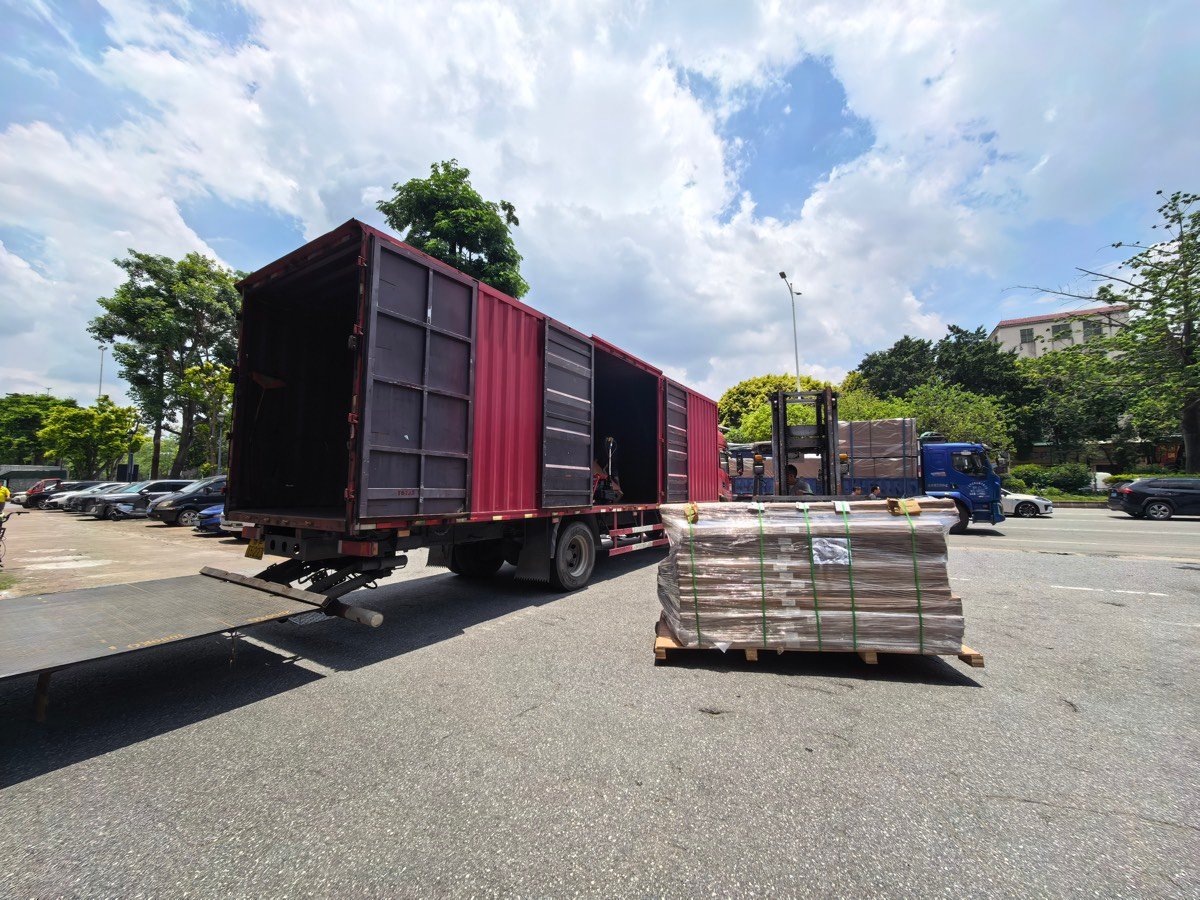
Mixed building-material shipments usually become difficult at the handoffs. One supplier is late. A warehouse counts cartons while the jobsite counts product units. Hardware is packed separately from the doors it belongs to. The buyer receives loading photos, but no one can match those photos to an order line.
The goal of this checklist is not to prescribe how a container must be packed. It is to keep each supplier line, package, exception and receiving result traceable from consolidation through arrival.
Quick answer: how do you control a mixed-materials shipment?
Use four linked controls: a supplier-readiness gate before consolidation, one package register that separates package count from item quantity, one named owner for the current exception log, and matched evidence at origin and destination. Decide late-supplier exceptions before the loading cutoff. Then give the receiving team the same package IDs, item quantities and discrepancy path used during loading.
What real buyers are trying to prevent
Public logistics and construction discussions show where apparently simple shipments become disputes:
- A buyer coordinating seven suppliers asked for a receiving report with carton counts by supplier and photographs.
- In one construction receiving case, the site counted boxes as product units, although some boxes contained more than one fixture.
- A home-building customer described multiple deliveries without a final bill of materials or delivery slip.
- A project buyer sourcing a pole barn and new home asked how to collect materials from several Foshan companies and pack them into one container.
These examples are not survey data, and they do not establish how every shipment behaves. They do expose a recurring operational problem: the cargo may be moving while the information needed to identify it is not.
1. Set a readiness gate before consolidation
Do not define “ready” as “the supplier says it is almost finished.” Give every supplier line a dated status against the same gate. At minimum, distinguish:
- production complete;
- quantity checked against the accepted order revision;
- packing scope confirmed;
- package count and actual packed data available;
- required documents available for review;
- delivery to the consolidation point booked or completed;
- exception owner and next decision time recorded.
If a supplier misses the gate, make the trade-off visible before the cutoff. The right answer depends on the goods, route, project sequence and commercial terms, but the decision should not remain implicit.
On a small screen, scroll the table horizontally to view all columns.
| Option | Consider it when | Record before deciding |
|---|---|---|
| Wait and consolidate later | The late item is essential to installation or splitting would create greater project risk | New ready date, storage exposure, next cutoff, revised arrival estimate and decision owner |
| Split the shipment | Ready goods are time-critical and the missing line can travel and clear separately | Extra freight and document work, package references, destination handling and how the second shipment will be matched |
| Ship without the item and replace or re-source it | The item can be sourced separately without breaking the approved specification or project sequence | Approval for the change, specification control, cost, lead time and who closes the original order-line exception |
| Hold only the affected supplier line | Other suppliers can proceed without losing traceability or creating incomplete functional sets | Exactly which order lines are held, linked accessories and the revised register issued to both origin and destination |
The output of this step is a decision record, not a vague message such as “one item may follow.”
2. Use one supplier and package register
A packing list is commonly used as a package-by-package account of the goods, including weights and measurements. The U.S. International Trade Administration provides a useful packing-list overview, but the responsible forwarder and importer should confirm the documents required for the actual route.
For a mixed project order, add a coordination layer that connects each physical package to the accepted order and the place where the receiver will use it.
On a small screen, scroll the table horizontally to view all columns.
| Field | Record | Prevents |
|---|---|---|
| Supplier ID | Supplier name or controlled code | Losing supplier-level accountability after consolidation |
| Order revision and line | The accepted revision plus line number | Comparing the delivery with an obsolete list |
| Package ID | A unique mark printed on the package and register | Unidentified cartons and photo folders |
| Package count | Number of cartons, crates, pallets or bundles | Treating packaging units as product units |
| Item description | Controlled product description or model reference | Mismatches between labels, invoice and project schedule |
| Item quantity and unit | Pieces, sets, metres or another agreed unit | “Four boxes” being mistaken for “four products” |
| Project location | Room, floor, opening or installation zone when useful | The jobsite reopening every package to find one item |
| Linked parts | Hardware, frames, panels or accessories packed elsewhere | Functional sets arriving incomplete at the work area |
| Packed data | Actual or declared dimensions and weight, clearly labelled | Estimates being reused as measured values |
| Status and exception | Ready, held, changed, received or loaded, with date | Old status circulating after a change |

Keep package quantity and product quantity in separate fields. For example, two cartons may contain four light fixtures, while one door opening may require a leaf package, a frame package and a hardware package. A total-package count cannot resolve either case by itself.
The register can supplement required shipping documents; it does not replace them. The ITA distinguishes a packing list from a commercial invoice and notes that shared information should agree. See its overview of common export documents.
3. Assign one owner to the current exception log
Several suppliers, a consolidation warehouse, a forwarder and a jobsite can each hold a correct fragment of the story while no one holds the current version.
Name one coordination owner for the live exception log. This person does not become legally or technically responsible for every party’s work. The role is to maintain the shared record, request decisions and circulate revisions to the named contacts.
Use a compact exception format:
On a small screen, scroll the table horizontally to view all columns.
| Exception | Affected reference | Current impact | Owner | Decision needed by | Resolution and revision |
|---|---|---|---|---|---|
| Supplier not ready | Supplier 03 / lines 18-22 | May miss consolidation cutoff | Named coordinator | Date and time | Wait, split, hold or approved replacement |
| Package label mismatch | PK-041 | Cannot reconcile with register | Warehouse contact | Before loading | Relabel and issue revised register |
| Accessory package held | PK-067 linked to doors D-12 to D-18 | Door sets incomplete at site | Buyer contact | Before seal | Hold related goods or document follow-on shipment |
| Visible package damage | PK-088 | Contents require a defined check | Packing team contact | Before loading | Repack, inspect or hold, with evidence reference |
Avoid maintaining the same exception independently in email, messaging apps and spreadsheets. Pick one current record, add a revision date, and archive superseded versions away from the active file.
4. Match loading evidence to the register
Agree the evidence plan before loading begins. Generic photographs taken after the fact rarely answer which supplier line or package was present.
An origin handover can include:
- the final supplier/package register and revision;
- a supplier-level receiving count at the consolidation point;
- visible package IDs and condition records;
- loading photographs linked to package groups or positions where safely practical;
- the container and seal references where applicable;
- unresolved exceptions, held goods and follow-on shipment references;
- the named origin and destination contacts.

A loading photo proves only what is visible from that angle at that moment. It does not prove the contents of a closed package, conformity to the approved product specification, or the condition of every concealed surface.
Product acceptance should therefore remain a separate control. For relevant categories, connect the register to the approved specification and inspection result. See the door and window pre-shipment inspection guide.
5. Let qualified parties decide protection, securing and VGM

Share the actual product and packed dimensions, weights, surface requirements, projecting parts and manufacturer handling instructions with the responsible packing and logistics teams. A generic product photograph is not enough to prescribe a crate, stacking pattern, moisture treatment or restraint method.
The joint IMO/ILO/UNECE CTU Code provides guidance for people responsible for packing and securing cargo transport units. Cargo-specific decisions should remain with competent parties.
Verified gross mass is also a separate shipping control, not an informal sum of catalogue weights. IMO states that for shipments within the relevant SOLAS requirements, the shipper must provide the verified gross mass before vessel loading. Confirm the applicable method and deadline with the shipping parties. See IMO’s VGM guidance.
6. Give the receiving team a before-signing checklist
The arrival check is not a complete product acceptance inspection. Its immediate job is to preserve traceability and document visible discrepancies while the delivery context is still available.
Before signing, where the delivery process and local rules allow, the receiving contact should:
- confirm the shipment, container or delivery reference;
- compare the package count with the current register, by supplier or package group where possible;
- scan or read package IDs instead of relying only on an aggregate pallet count;
- note visibly missing, opened, crushed, wet or otherwise damaged packages;
- photograph relevant package IDs and visible conditions;
- record discrepancies on the available delivery record rather than only in a later message;
- separate “package received” from “contents and specification accepted”;
- notify the named exception owner through the agreed route.
Claims, signing language, inspection rights and notice periods depend on the contract, carrier, insurance and local rules. Agree that procedure with the responsible commercial and logistics parties before arrival.
Worked example: three packages do not mean three complete door sets
This illustrative example is not a HARDWORKING shipment or a packing specification.
On a small screen, scroll the table horizontally to view all columns.
| Package ID | Contents | Item quantity | Project reference | Status |
|---|---|---|---|---|
| PK-101 | Door leaves | 2 pieces | Openings D-01 and D-02 | Loaded |
| PK-102 | Frames | 2 sets | Openings D-01 and D-02 | Loaded |
| PK-103 | Hardware kits | 2 sets | Openings D-01 and D-02 | Held: supplier exception |
If the jobsite receives two packages, it has not received two complete door sets. If the loading record says only “two cartons loaded,” the receiver cannot see the functional shortage. The linked package IDs, item quantities and held-status note make the exception visible before installation starts.
Frequently asked questions
One supplier missed the consolidation cutoff. Should we wait or split the shipment?
Compare the project need date, whether the missing line blocks installation, the next cutoff, storage exposure, added freight and document work, and the risk of separating linked parts. Record one explicit decision—wait, split, hold or approved replacement—with an owner and deadline. There is no safe universal answer based only on carton count.
Does the carton count prove how many products were shipped?
No. A package is not automatically a product unit. Record package count and item quantity separately, using an agreed unit such as pieces, sets or metres. Cross-reference split components and accessory boxes so the receiver can distinguish “package present” from “complete product set present.”
Do container-loading photos prove that every item was loaded?
No. Photos are supporting evidence for visible packages and conditions. They become more useful when linked to package IDs and the final register, but they cannot prove hidden contents, concealed condition or specification conformity.
Can one packing list cover several suppliers and material categories?
A shared coordination register can cover them if it preserves supplier, order-line, package, item-quantity and project-location references. Confirm the formal shipping-document format with the forwarder, exporter and importer; do not assume the project register replaces required documents.
What should the receiving team record before signing?
Record the applicable shipment reference, package count, package IDs and visible condition. Photograph discrepancies with the relevant IDs and note them through the agreed delivery process. Keep “received package” separate from later checks of contents, dimensions, finish, function or specification.
What should I send HARDWORKING first?
Send the current product list, quantities and units, destination, required date, project-location references, linked accessory information, and any packing or receiving requirements. The building materials RFQ checklist can help organize the starting details. Available packing and export coordination is confirmed against the actual project.
Prepare the record before the cargo moves
A mixed shipment is easier to receive when the decision trail travels with the goods: one readiness gate, one current register, visible exceptions and the same package references at both ends.
Send your project list and packing requirements.
Research note: this guide was revised on September 20, 2026 after reviewing nine public buyer and logistics discussions across Reddit and construction forums. Those discussions were used to identify customer questions; official trade and cargo guidance was used for documentary and technical boundaries. The article does not treat public anecdotes as universal evidence or replace route-specific professional advice.
Ready to organize your project requirements?
Share drawings, quantities, room sizes or reference images through the project inquiry form.